Pick Your Fire: The Career-Defining Choice Between Lampworking and Furnace Glassblowing
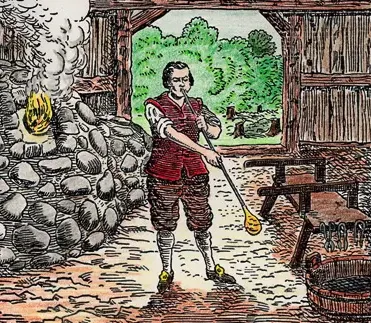
Photo: NPS image, CC BY 4.0, via Wikimedia Commons
Every glassblower eventually faces the same crossroads. You've caught the bug — maybe you took a weekend class, maybe you stumbled across a YouTube rabbit hole at 2 a.m. — and now you're trying to figure out which direction to go. Torch or furnace? Lampwork or hot shop? It sounds like a simple equipment question. It's not. The choice you make here quietly shapes your technique, your income, your studio setup, your community, and honestly, the kind of artist you'll become over the next decade.
We dug into this with working artists from both camps to get past the surface-level comparisons and into the stuff that actually matters when you're building a real practice.
What We're Actually Talking About
First, a quick grounding for anyone still getting their bearings. Lampworking — also called torch work — involves working with a bench-mounted torch that burns oxygen and propane (or natural gas) to produce a focused, high-temperature flame. Artists manipulate glass rods and tubes, usually borosilicate or soft glass, at close range. The work is precise, often intricate, and done sitting down.
Furnace glassblowing is the full hot shop experience: a 2,000-plus degree furnace holding a crucible of molten glass, a blowpipe, a glory hole for reheating, and a lot of movement. It's physical, collaborative, and loud. The glass you're working with is soft soda-lime glass, and the scale of what you can make — and the equipment you need — is dramatically different.
Both are legitimate, serious disciplines. But they attract different kinds of people, support different business models, and demand different things from your body, your wallet, and your schedule.
The Money Question Nobody Asks Up Front
Let's start where most guides don't: the financial reality.
Setting up a lampworking station is genuinely accessible by comparison. A solid beginner torch setup — think a Minor Bench Burner or a Nortel Mid-Range — plus a kiln, basic tools, and a ventilation system can run you anywhere from $2,000 to $6,000 depending on how you source your equipment. You can do it in a spare bedroom, a garage, or a basement with the right ventilation. That low barrier to entry is a big part of why lampworking has exploded in the last fifteen years, especially among artists who want to work independently without relying on shared studio time.
Furnace glassblowing is a different financial animal entirely. A gas-fired furnace alone can cost $15,000 to $30,000 new, and that's before you factor in the glory hole, the annealer, the bench, tools, gas infrastructure, and the kind of space that can safely house all of it. Most people who pursue furnace work do so through shared studios, residency programs, or university glass programs — at least initially. You're looking at either a significant capital investment or a long-term dependence on institutional access.
"I did hot shop work for six years before I could afford my own setup," says Marcus Delray, a furnace-based artist out of Asheville, North Carolina. "You're basically renting access to your own craft for years. That shapes how you think about time, efficiency, and what you make."
Technical Skill Sets: Closer Than You Think, Further Than You'd Expect
Here's something that surprises a lot of beginners: the fundamental principles — heat management, surface tension, gravity, color chemistry — are the same across both disciplines. But the way those principles play out in practice is wildly different.
Lampworkers develop an almost surgical precision. Working at close range with small-diameter glass means you're reading subtle color shifts, managing heat gradients across millimeters, and building up complex structures one layer at a time. The control is extraordinary. Many lampworkers can produce detail work — intricate floral murrine, scientific glass components, ultra-fine beadwork — that simply isn't achievable at the furnace scale.
Furnace blowers develop a different kind of intelligence: spatial, physical, and collaborative. You're reading a gather of glass that weighs two pounds and moves in three dimensions. You're working against gravity, against cooling time, and often in coordination with a gaffer and one or two assistants. The physicality is real — your body is part of the tool.
"The torch teaches you to be a surgeon," says Priya Sandoval, a lampworker based in Portland, Oregon, who also trained in furnace work. "The furnace teaches you to be a conductor. Both are hard. They're just hard in completely different ways."
Market Realities: Who's Buying What
This is where the career implications get really interesting — and where a lot of new glassblowers make decisions they later regret.
Lampwork has a massive, established retail market. Beads, pendants, small sculptures, scientific glass, and decorative objects move well at craft fairs, on Etsy, through galleries, and increasingly through Instagram and TikTok. The price points are accessible — you can sell a lampwork bead for $15 or a complex pendant for $300 — which means you can move volume and build a customer base faster. The tradeoff is that the market is also more crowded, and competing on price with overseas production glass is a real pressure point.
Furnace work tends toward larger, higher-ticket pieces: vessels, sculptural works, architectural commissions. The market is narrower but the price ceiling is much higher. A serious furnace-blown vessel from an established artist can command $1,500 to $15,000 or more. The challenge is that building the reputation and collector relationships to sell at those price points takes years — and you need consistent studio access to build a body of work in the first place.
"I know lampworkers clearing six figures on Etsy and Instagram," says Delray. "I also know furnace artists with waiting lists for $8,000 pieces. Neither path is easy, but they require completely different business strategies."
Community and Culture
This one's underrated. The glassblowing community is tight-knit, but the torch world and the hot shop world have genuinely different cultures.
Lampworking skews more toward solo practice, online community, and a strong DIY ethos. Forums, Facebook groups, and YouTube tutorials are how a lot of torch workers learn and connect. It's more geographically distributed — you don't need to live near a major studio to practice.
Furnace glassblowing is inherently more communal. You almost always need help, which means you're constantly working alongside other artists, trading studio time, assisting on each other's pieces. Programs like the Pilchuck Glass School in Washington or the Penland School of Crafts in North Carolina are central gathering points. The mentorship culture is strong, and your network matters enormously.
So Which One Is Right for You?
Honestly, there's no universal answer — which is a cop-out answer, so let's be more specific.
If you're self-directed, working with a limited budget, want to build an independent business from home, and love intricate detail work, lampworking is probably your faster path to a sustainable practice. If you're drawn to large-scale work, thrive in collaborative environments, have access to institutional studio space, and are willing to play a longer game to build your market, furnace work might be where you belong.
And plenty of serious artists do both. The technical cross-training is genuinely valuable — lampwork precision informs furnace control, and furnace-scale thinking opens up new possibilities at the torch. But most working artists eventually specialize, because mastery in either discipline demands real focus.
The torch and the furnace are both legitimate paths to a serious career in glass. The question isn't which one is better. It's which one fits the life you're actually trying to build.