Six Figures and Smoke: What's Really Keeping Glassblowers From Breaking the Income Barrier
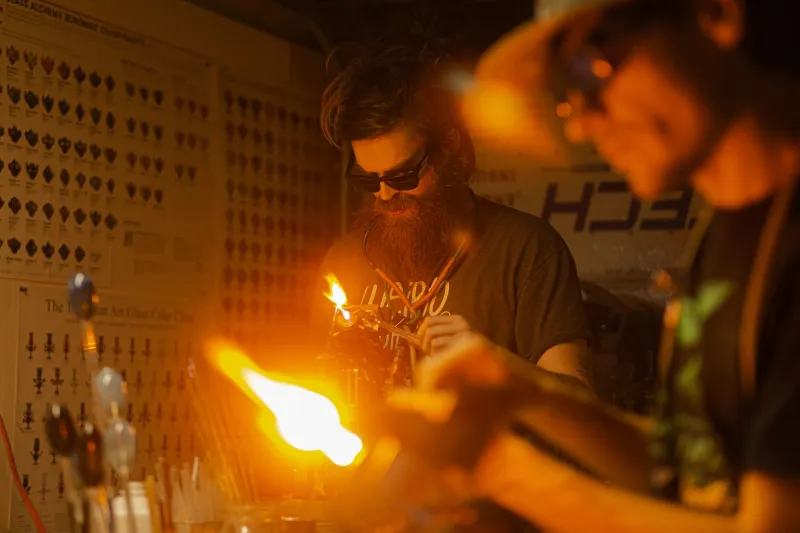
Here's a scenario that plays out in hot shops across the country more often than most people admit: a glassblower is genuinely talented, consistently busy, and working themselves half to death — and still clearing somewhere between $55,000 and $85,000 a year. They're not failing. But they're not winning either. They're stuck.
The frustrating part? The problem usually isn't the glass. It's everything around the glass.
We talked to studio owners, working artists, and a few business consultants who specialize in craft-based businesses to figure out exactly what's creating that ceiling — and, more importantly, what it takes to punch through it.
The Time-for-Money Trap Is Real, and It's Brutal
Glassblowing is a physically demanding, time-intensive craft. You can only spend so many hours in front of a glory hole before your body starts sending invoices. That hard ceiling on production hours is the first and most fundamental constraint every solo blower runs into.
If you're making $400 pieces and you can realistically produce 15 of them a week, you're looking at a theoretical gross of around $312,000 annually — before materials, equipment, rent, utilities, and the fact that you're human and need sleep. Once you subtract actual costs and account for the reality that you won't sell every piece instantly, that number shrinks fast.
The math forces a choice: either raise your prices, increase your output capacity, or find ways to generate revenue that don't require you personally to be standing at the bench. Most blowers resist all three of these options for reasons that are completely understandable but financially self-defeating.
Underpricing Is an Epidemic — And It's Not Just About Confidence
Talk to almost any glassblower who's made it past the six-figure mark and they'll tell you the same thing: they spent years leaving money on the table. Chronic underpricing is so common in the craft world that it's practically a rite of passage.
But here's what's interesting — it's not always low self-esteem. A lot of experienced blowers underprice strategically, or at least what they think is strategically. They're afraid that raising prices will kill their sales velocity. They've built a customer base around a certain price point and they don't want to alienate those buyers. They're watching what other blowers charge and unconsciously anchoring to that.
The problem is that pricing isn't just about covering costs plus a margin. It's also a signal. Collectors — especially serious ones — often associate higher prices with higher quality and greater collectibility. A $250 vase and a $900 vase don't just represent different price points; they represent different markets entirely. Moving up-market requires a mindset shift that a lot of artists genuinely struggle with.
Melissa Tran, a studio glass artist based in Asheville, North Carolina, says she didn't crack $100K until she stopped thinking about what her work was worth and started thinking about what her ideal customer expected to pay. "I tripled my prices on my gallery work over two years," she says. "I lost some buyers. I gained better ones. The math worked out way in my favor."
Retail vs. Wholesale: Picking the Wrong Channel for Your Business
Another massive bottleneck: the retail-versus-wholesale trap. Both channels have merit, but blowing your production capacity on wholesale accounts that pay 50 cents on the dollar can quietly strangle a studio's income potential.
Wholesale relationships with galleries and gift shops feel like validation — and they are, to a point. But if you're giving a retail partner a 50% margin on a piece that took you four hours to make, you've essentially cut your effective hourly rate in half. For high-volume, lower-complexity work, that can still pencil out. For intricate, time-intensive studio pieces, it often doesn't.
The blowers who break through the income ceiling tend to have a deliberate channel strategy. They might use wholesale relationships to move functional, production-oriented work — things they can make efficiently — while reserving their highest-margin, most complex pieces for direct sales through their own website, Instagram, or studio open houses.
Direct-to-collector relationships are almost always more profitable per piece. The tradeoff is that they require more marketing effort and relationship management. That's a real cost too, just not one that shows up as a line item on a materials invoice.
The Scaling Paradox: Growing Without Burning Down
So you've raised your prices and tightened your channel strategy. Now what? For a lot of blowers, the next logical step is expanding — hiring an assistant, taking on apprentices, or adding studio time. This is where things get genuinely complicated.
Adding even one part-time employee introduces a layer of operational complexity that surprises a lot of solo artists. Payroll, scheduling, training, liability, the fact that your assistant will occasionally break things — it all adds friction. And if your systems aren't already solid, scaling just amplifies the chaos.
The studios that manage this transition well tend to document their processes obsessively before they hire. They know their production costs down to the dollar, they have a clear sales pipeline, and they've already stress-tested their pricing at a higher output level. The ones that struggle hire first and figure out the rest later.
Kevin Marsh, who runs a mid-size production studio in Portland, Oregon, put it plainly: "I hired my first assistant when I was already overwhelmed, which was exactly the wrong time. I should have hired when I had breathing room to train someone properly. Instead I was teaching on the fly while drowning in orders. We made it work, but it was ugly."
Revenue Streams You're Probably Ignoring
Here's the lever that a surprising number of six-figure glassblowers pull that their stuck peers haven't considered: diversifying beyond direct sales.
Teaching classes is the obvious one, and plenty of studios already do it. But there's a wide spectrum between a casual Saturday intro class and a structured curriculum that commands premium pricing. Intensive multi-day workshops for serious hobbyists, for example, can generate $500–$1,500 per student per weekend. If your studio can run those monthly, that's a meaningful chunk of additional revenue that doesn't depend on you selling finished pieces.
Commission work — custom pieces for interior designers, architects, restaurants, and hospitality brands — is another underutilized channel. These clients often have larger budgets than individual collectors and a genuine need for one-of-a-kind work. Building relationships with interior design firms in your region can open doors that craft fairs and gallery shows simply can't.
Licensing your designs, creating limited-edition collections with documented provenance, and building a waiting list for your most sought-after work are all strategies that successful blowers use to shift the supply-demand dynamic in their favor.
Breaking Through Is a Business Problem, Not a Glass Problem
The artists who consistently earn six figures aren't necessarily the most technically gifted people in their region. They're the ones who treat the business side of glassblowing with the same seriousness they bring to the craft itself.
That means knowing your numbers cold. It means making deliberate decisions about pricing, channels, and capacity instead of just reacting to whatever opportunity shows up. It means being willing to say no to low-margin work, even when it feels uncomfortable.
The glory hole doesn't care about your revenue goals. But you should — and the good news is that the path from stuck to sustainable is a lot more navigable than it looks from the middle of the plateau.