Still Standing at the Furnace: How Veteran Glassblowers Beat Burnout and Build Careers That Last
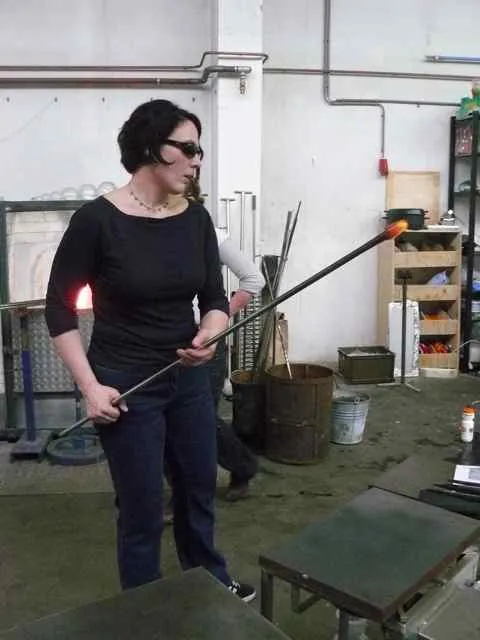
Photo: Anne gant, CC BY-SA 4.0, via Wikimedia Commons
There's a version of the glassblowing story that nobody puts on Instagram. It doesn't involve a perfectly gathered gather or a symmetrical vessel cooling in the annealer. It looks more like a 36-year-old artist with a blown-out shoulder, chronic fatigue, and a creeping sense that the craft they sacrificed everything for has quietly stopped giving anything back.
Burnout in the hot shop is real, it's common, and it ends careers. The glassblowing world tends to celebrate the grind — the long hours, the brutal heat, the obsessive repetition required to develop real skill. What it doesn't talk about nearly enough is the cost of that grind, or the fact that a lot of gifted artists simply don't make it past their mid-thirties before something gives out. Sometimes it's a shoulder or a spine. Sometimes it's the mental load. Often, it's both at once.
We spent time talking to blowers across the country who've logged 20 or more years at the furnace. What they shared wasn't a single magic formula — it was a collection of hard-won habits, mindset shifts, and structural changes that, together, make the difference between a career and a cautionary tale.
The Physical Reality Nobody Warns You About
Let's start with the body, because that's usually where the first cracks appear.
Glassblowing demands a kind of sustained physical output that most people outside the craft don't fully appreciate. You're working in ambient temperatures that routinely exceed 100°F, rotating heavy blowpipes for hours at a stretch, repeating asymmetrical movements that load the same joints over and over again. The shoulders and lower back take the brunt of it, but repetitive stress injuries show up in wrists, elbows, and necks too.
Veteran blowers who've stayed healthy share one consistent habit: they started treating their bodies like athletes do, not like artists typically do. That means intentional warm-up routines before stepping near the furnace, regular strength and mobility work outside the studio, and — maybe most importantly — actually listening when something hurts instead of pushing through it.
"I spent my twenties thinking pain was just part of the deal," said one Oregon-based blower who's been working glass for 23 years. "By the time I was 32, I had a rotator cuff issue that almost ended everything. Physical therapy changed how I approached the whole craft. Now I treat a rest day like a tool, not a failure."
The blowers who last also tend to be strategic about their production schedules. Marathon eight-hour solo sessions might feel productive, but they're a fast track to cumulative injury. Breaking work into focused two- to three-hour blocks with genuine recovery time between them isn't just better for the body — most veterans report it actually improves the quality of their work.
When the Mental Load Gets Heavy
The physical piece gets some attention, at least in safety conversations. The mental side of burnout is far less discussed, and in some ways more insidious.
Glassblowing is a craft that punishes inconsistency. The material doesn't care if you're tired, distracted, or going through something hard — it responds the same way regardless, which means a lot of blowers develop an almost adversarial relationship with their own emotional states. Feelings become obstacles to the work rather than part of the human experience of making it.
Combine that with the financial pressure most working artists carry, the isolation of solo studio practice, and the social media environment that rewards constant output and visible success, and you've got a recipe for serious mental exhaustion.
The artists who've navigated this successfully tend to have a few things in common. Many of them have built deliberate community into their practice — whether that's a shared studio arrangement, a regular critique group, or just consistent relationships with other makers who understand the specific texture of this life. Isolation accelerates burnout. Connection slows it down.
Several veteran blowers also pointed to the importance of creative range — maintaining areas of exploration that exist outside commercial pressure. When every piece you make has to sell, the joy of experimentation gets squeezed out fast. Protecting some portion of your studio time for work that has no audience, no price tag, and no expectations is something the long-haulers treat as non-negotiable.
Adapting the Practice Over Time
One of the most interesting patterns among blowers with long careers is a willingness to let the practice evolve — not as a compromise, but as a form of intelligence.
Some have shifted toward smaller-scale work as their bodies have changed, finding that the constraints actually pushed their artistry in directions they wouldn't have explored otherwise. Others have moved into teaching, which extends their engagement with the craft while reducing the physical output required. A few have built collaborative studio models where the heavy production work is shared, allowing them to focus on design and finishing.
None of them frame these shifts as giving up. They frame them as survival — and as proof that glassblowing is deep enough to sustain a career across multiple phases if you're willing to let it change shape.
"The artists I've watched burn out were usually the ones who decided early on what glassblowing had to look like for them and refused to budge," said a Wisconsin-based blower with 27 years in the craft. "The ones who stick around are the ones who stay curious about what the next chapter could be."
What the Survivors Actually Do Differently
After all these conversations, a few clear themes emerged:
They set hard limits on hours. Not as a goal, but as a non-negotiable. The romantic idea of losing yourself in the studio indefinitely is a young person's luxury.
They invest in their bodies before things break. Strength training, mobility work, ergonomic adjustments to their setup — these aren't afterthoughts, they're part of the job.
They maintain relationships outside the craft. Friendships, family, interests that have nothing to do with glass. These aren't distractions from the work; they're what makes the work sustainable.
They protect creative play. Some studio time that belongs entirely to experimentation, with no commercial obligation attached.
They ask for help. Whether that's a physical therapist, a business partner, a mental health professional, or just a fellow blower who's been through it — the long-haulers don't white-knuckle through hard stretches alone.
The Conversation the Industry Needs to Have
Glassblowing has a culture problem around toughness. The craft's difficulty is worn as a badge of honor, which is understandable — it is genuinely hard, and the skill required is real. But that same culture makes it difficult to admit when you're struggling, and it quietly pushes people toward decisions that shorten careers.
The artists who are still at the furnace after two decades aren't the ones who worked the hardest without complaint. They're the ones who figured out, usually through some painful lesson, that longevity requires a different kind of discipline — one that includes rest, adaptation, community, and the willingness to put the blowpipe down before the body demands it.
The glory hole will be there tomorrow. The question is whether you will be.