Locked in the Hot Shop: The Hidden Psychology Keeping Your Best Glass off the Wall
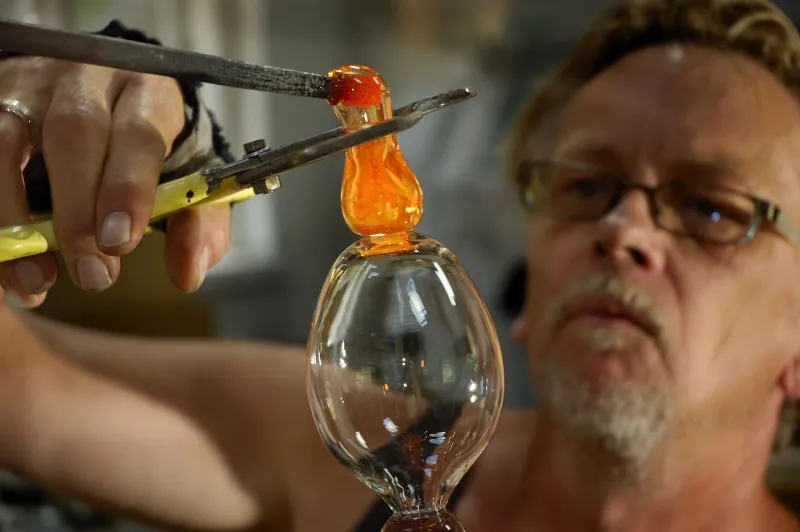
There's a shelf in a Portland studio that its owner, a 14-year veteran glassblower named Marcus, half-jokingly calls "the graveyard." It holds roughly two dozen pieces — some of the most technically daring work he's ever produced. Intricate internal lattice structures. A series of asymmetrical vessels that pushed his color chemistry into genuinely new territory. A sculptural form he spent three weeks refining.
None of it has ever been shown publicly. Most of it, he admits, probably never will be.
"Those are the pieces I actually care about," he says. "Which is exactly why I can't let anyone see them."
If that logic sounds backwards, you're not alone in thinking so. But spend any time talking to working glassblowers across the country and you'll hear versions of Marcus's story repeated with surprising consistency. The work artists are most proud of — the pieces that represent genuine creative risk — often ends up hidden away, while safer, more "sellable" work gets the spotlight. It's a phenomenon that doesn't get nearly enough airtime in the glassblowing community, and it's quietly stunting creative growth across the craft.
The Perfectionism Spiral
Glassblowing has a built-in perfectionism problem. The medium is brutally unforgiving — you're working against gravity, time, and physics simultaneously, and the window for correction is measured in seconds, not hours. That environment breeds a particular kind of hyper-critical self-assessment that doesn't always switch off when the piece goes into the annealer.
Sarah, who runs a shared studio space in Asheville, North Carolina, describes it as "the cooling-down curse." "When a piece is still hot, you're in the zone — you're just making decisions," she explains. "But the second it starts cooling, your brain kicks in and you start cataloguing everything that went slightly wrong. By the time it's room temperature, you've convinced yourself it's garbage."
The problem is that this critical faculty — genuinely useful during the making process — doesn't distinguish between technical imperfection and creative boldness. A piece that takes real stylistic risks will almost always have more "flaws" than a piece you've made a hundred times before. The brain reads novelty as error. And so the most innovative work gets quietly shelved.
Research in creative psychology backs this up. Studies on what's sometimes called "the vulnerability of originality" suggest that people are significantly more likely to reject their own novel ideas than conventional ones, even when outside observers rate the novel work more highly. Glassblowers aren't uniquely prone to this — but the physical permanence of the medium makes the stakes feel higher. A bad paragraph can be deleted. A bad pot can be smashed. A bad blown piece sits there on your shelf, a three-dimensional record of your ambition.
Imposter Syndrome at 2,100 Degrees
For many glassblowers, the deeper issue isn't perfectionism about the work itself — it's a gnawing sense that they haven't yet "earned" the right to make unconventional pieces.
This is imposter syndrome, and it runs rampant in craft communities where skill hierarchies are highly visible. Glassblowing has a long tradition of mentorship and apprenticeship, which creates a strong sense of lineage and legitimacy. That can be a beautiful thing. It can also make artists feel like they need permission — from their teachers, from established galleries, from the broader community — before they're allowed to experiment.
Derek, a self-taught blower based outside of Denver, puts it bluntly: "I never went to Pilchuck. I didn't apprentice under anybody famous. So when I make something that feels genuinely new to me, there's always this voice saying, 'Who are you to think this is worth showing?'"
The irony is thick. Self-taught artists often bring the freshest perspectives to the craft precisely because they haven't internalized its conventions as deeply. But the same outsider status that enables creative freedom also feeds the imposter narrative that keeps the work hidden.
Fear of the Wrong Kind of Attention
There's another layer here that's worth naming directly: fear of criticism from within the community itself.
Glassblowing circles, particularly in established hot shop communities, can be intensely tribal. Technique is discussed with almost religious seriousness, and departures from tradition are sometimes met with skepticism that reads more like gatekeeping. Several artists we spoke with described hesitating to show experimental work specifically because they anticipated dismissal from peers whose opinions they valued.
"There's a difference between a collector not liking your work and another glassblower thinking you don't know what you're doing," says Jenna, who teaches at a community studio in Chicago. "The collector thing stings. The peer thing feels like it means something about whether you belong here."
Social media has complicated this further. The glassblowing community online can be wonderfully supportive — but it's also a space where conventional, highly polished work tends to perform better algorithmically than genuinely strange or experimental pieces. When your most innovative work gets fewer likes than your bread-and-butter vessels, it's easy to read that as confirmation that the work isn't good enough, even when the reality is just that algorithms favor familiarity.
Breaking the Lock
So what actually works? We asked artists who've managed to push past these barriers to share what helped.
Show the process, not just the product. Several artists mentioned that documenting their experimental work in progress — posting videos of the making rather than just the finished piece — created a different kind of engagement that felt lower-stakes. "When people see how something was made, they respond to the effort and the thinking," says Sarah. "It shifts the conversation away from 'is this good' to 'isn't this interesting.'"
Find a small, trusted audience first. Marcus eventually started showing his graveyard shelf pieces to a small group of fellow artists before considering any public exhibition. "Getting a reaction from people I trust, in a low-pressure context, broke the spell a little," he says. "Once a few people responded to a piece, it stopped feeling like a liability."
Separate making from showing. Some artists find it helpful to commit to a rule: finish the piece and put it in the annealer before you decide anything about whether it gets shown. The decision to exhibit is a separate creative act from the decision to make. Conflating them at the furnace kills risk-taking.
Set a deadline for the graveyard. If a piece has been sitting on your shelf for six months and you haven't smashed it, consider that a vote in its favor. Give yourself a rule: anything that survives a certain amount of time gets at least one public showing.
The broader point is this — the glassblowing community loses something real when its most adventurous work stays locked in studios. The craft evolves through what gets shared, discussed, and built upon. Every piece that never leaves the hot shop is a conversation that never happens.
Marcus is still thinking about that shelf. He's not ready to call it anything other than a graveyard. But he did recently photograph one of the pieces and post it online — no caption, no explanation, just the work.
The response surprised him.
It usually does.