Position Is Everything: How Your Glory Hole Placement Shapes Every Piece You Make

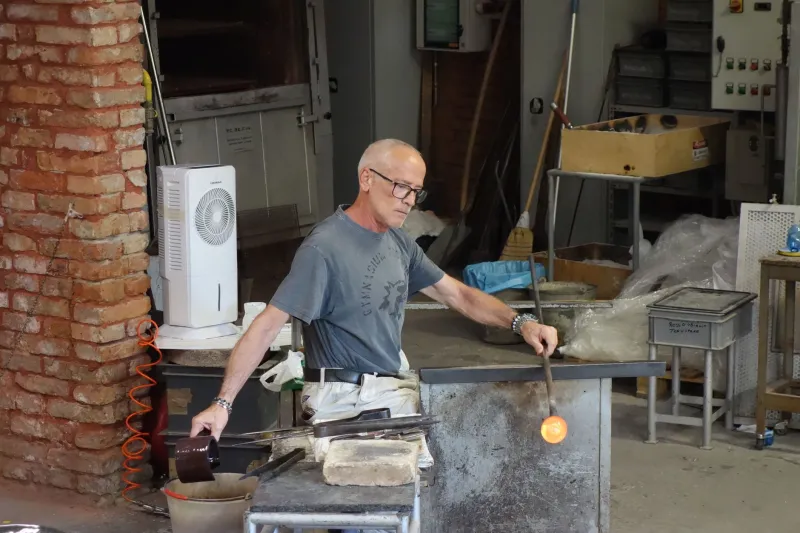
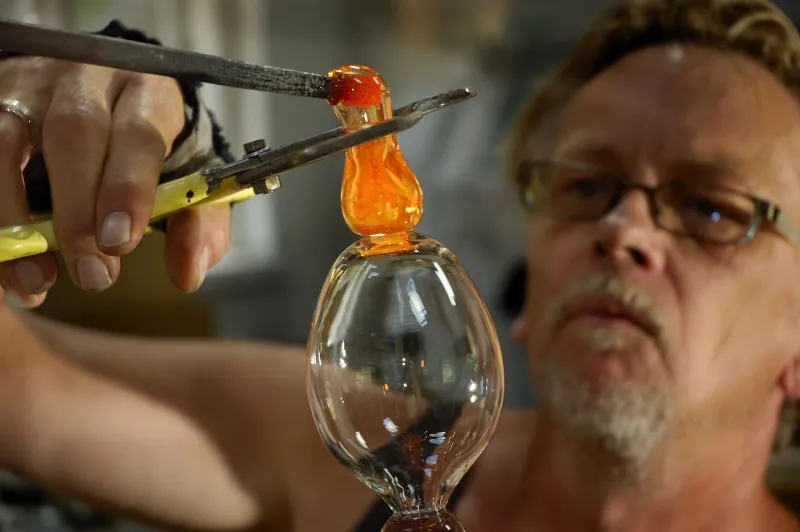
Photo: glassblower reheating glass in glory hole furnace hot shop studio, via facts.net
Ask ten glassblowers what makes a great studio, and you'll get ten different answers. Furnace quality, annealer capacity, bench height, lighting—everyone has their pet theory. But spend enough time talking to serious production blowers and working artists across the US, and a surprising consensus starts to emerge: the placement and orientation of your glory hole might be the single most underappreciated variable in the whole hot shop.
We're not talking about brand or BTU output. We're talking about where the thing physically lives in your space, how it's angled relative to your bench, and how those spatial relationships quietly shape everything from your heat consistency to the way your colors develop. It sounds almost too simple. It isn't.
Why Placement Gets Ignored in the First Place
Here's the honest truth: most studio setups aren't designed from scratch with ideal workflow in mind. They're inherited. You rent time in a co-op studio that was laid out fifteen years ago by someone who was figuring it out as they went. Or you build your home shop around whatever corner of the garage you could clear out. The glory hole goes where it fits, not necessarily where it should go.
That means a huge percentage of working blowers have never actually experienced what their equipment can do when it's positioned optimally. They've adapted to the constraints of their space so thoroughly that the constraints have started to feel like physics.
They're not.
The Basic Geometry of Heat Access
Let's start with the fundamentals. A glory hole is essentially a reheating chamber—a high-temperature environment you're introducing your work into to keep it workable. The way heat moves inside that chamber, and the way you access it, is deeply affected by how your body, your bench, and the opening of the glory hole relate to each other in three-dimensional space.
The classic American hot shop setup places the glory hole to the blower's dominant side, with the opening roughly at elbow height when seated at the bench. This layout prioritizes quick, fluid transitions between gathering and reheating. It works well for symmetrical forms where you're rotating the piece constantly and need consistent, even exposure across the whole gather.
But that's not the only approach—and for certain types of work, it's not even the best one.
Angle and Rotation: More Connected Than You Think
One of the more interesting things experienced blowers talk about is the relationship between glory hole opening angle and rotation control. When your glory hole sits perfectly perpendicular to your bench and body, you're naturally inclined to rotate the piece in a flat, horizontal plane. That's great for round forms. It's less ideal when you're working on something with intentional asymmetry or a directional element, like a vessel with a pulled lip or a sculptural piece with a specific orientation.
Some artists—particularly those doing more sculptural or flameworked-adjacent hot glass—deliberately position their glory holes at a slight diagonal to their bench. This encourages a more varied rotational approach and makes it easier to introduce heat selectively to one side of a piece. It's a small adjustment, but it can genuinely change the way you interact with a form in progress.
If you're working in a shared studio, you obviously can't just reposition the glory hole on a Tuesday afternoon. But understanding this principle lets you compensate with your body positioning and bench height adjustments, which are usually within your control.
Heat Consistency and the Draft Problem
Here's something that doesn't get talked about enough: glory holes are sensitive to airflow patterns in your studio, and where yours sits in the room affects how stable its internal temperature is during a work session.
A glory hole positioned near a loading door, a large window, or even an HVAC vent is going to experience more temperature fluctuation than one tucked into a more sheltered corner of the shop. Every time that door opens or a draft moves through, you're introducing a variable into your reheating environment. Over the course of a long production session, those fluctuations add up. You may not consciously notice them, but your work does.
This is especially consequential for color work. Many reactive and striking colors are sensitive to temperature consistency during the working process. If your glory hole is running slightly cooler on one side of the opening because of a persistent draft from across the room, you might be getting uneven color development that you've been blaming on your chemistry or your gather technique. Check your positioning first.
The Distance Question
How far your glory hole sits from your bench matters more than most people think, too. The standard wisdom is to keep it close for efficiency—less travel time means the piece stays hotter between the bench and the reheating chamber. That's true, and in high-volume production work, those seconds genuinely add up.
But there's a counterargument worth hearing. Some blowers, particularly those doing larger-scale work or pieces that require significant manipulation at the bench, actually prefer a bit more distance. The slightly longer walk gives them a moment to assess the piece, plan their next move, and arrive at the glory hole with intention rather than just reflex. It's a built-in pause that can improve decision-making during complex sequences.
The right distance for your setup depends on what you're making and how you work. The point is to make that choice deliberately rather than just accepting whatever the previous tenant left behind.
What Top Blowers Actually Do
Talk to artists who have had the luxury of designing their own studios from the ground up—people like the veteran production blowers at established hot shops in Seattle, Portland, and Asheville—and you start to hear some consistent themes.
Many of them build in adjustability. Instead of a fixed glory hole position, they use equipment on castors or modular bench systems that let them shift the spatial relationships between their major equipment as their work evolves. What works for production runs of smaller vessels isn't necessarily ideal for larger sculptural work, and having the flexibility to adapt is worth the upfront investment in mobility.
Others talk about spending serious time early in their careers just observing how heat moves in different studio configurations—working in as many different shops as possible, not just to learn from other artists, but to internalize how different spatial setups feel in the body and affect the work.
Making It Work in the Studio You Have
If you're renting time in a shared space or working with a fixed setup, you're not powerless here. Start by mapping the airflow patterns in your studio at different times of day and under different door/window conditions. Identify whether your glory hole has any cold spots near the opening. Experiment with your body positioning relative to the opening—even shifting your stool a few inches can change your rotation geometry meaningfully.
And if you're ever in a position to influence a studio build or renovation? Make the case for flexibility. Castors, adjustable bench heights, and thoughtful placement relative to doors and vents aren't luxuries. They're the difference between a shop that fights you and one that works with you.
The glory hole is the heart of the hot shop. Treat its position like the design decision it actually is.