Hand Check: The Quiet Physical Toll That Ends Glassblowing Careers Way Too Soon
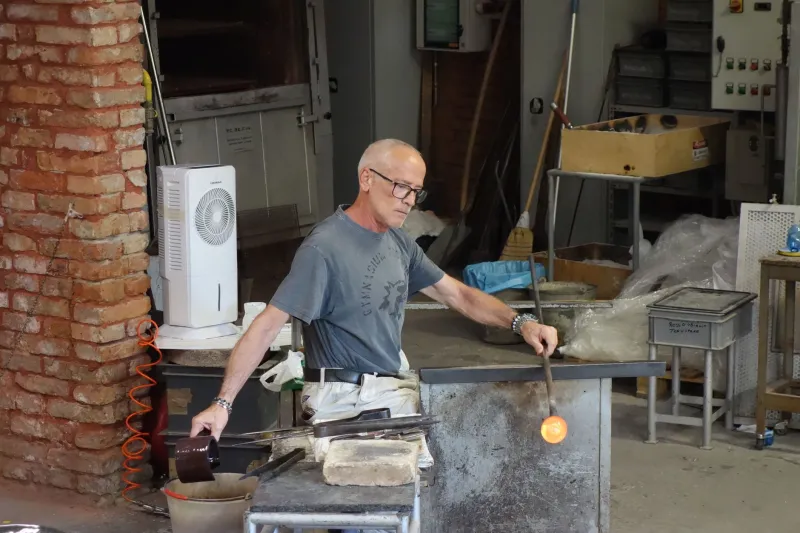
Photo: glassblower hands holding blowpipe hot shop studio, via grayferparquesinfantiles.com
Everybody talks about the heat. Ask someone what glassblowing is hard on, and nine times out of ten they'll mention the furnace, the radiant burn, the sweat-soaked shop in July. What they don't mention — at least not until it's too late — is the hands.
The hands are doing something almost constantly at the pipe. Rotating. Gripping. Squeezing jacks. Marvering. Transferring weight between tools. Over the course of a single long session, those motions stack up into thousands of micro-repetitions, each one placing load on tendons, joints, and the intricate web of soft tissue that makes fine motor control possible. Do that five days a week for a decade and you start to understand why so many veteran blowers keep a heating pad on the workbench.
"I see glassblowers in my practice and they always seem surprised," says Dr. Renata Osei, an occupational medicine physician based in Portland, Oregon, who has worked with a number of Pacific Northwest studio artists. "They come in thinking the issue is a one-time injury. But when we dig into their history, it's almost always cumulative. The body has been absorbing load for years and finally hits a threshold."
That threshold has a way of arriving at the worst possible time — right when a blower is hitting their stride creatively and technically.
What's Actually Happening to Your Hands
The mechanics of glassblowing create a specific and somewhat unusual injury profile. Unlike, say, a carpenter whose grip work is relatively static, a glassblower is constantly alternating between high-force grip and precise, low-load fine motor tasks. You're squeezing jacks hard enough to shape molten glass one moment, then feathering a tool with millimeter-level control the next.
That combination puts stress on multiple systems simultaneously. Tendons in the forearm — particularly those governing the flexor and extensor muscles — get hit hard by the rotation demands of keeping a gather centered on the pipe. The ulnar nerve, which runs along the inside of the elbow and into the ring and pinky fingers, is vulnerable to compression from prolonged gripping postures. Carpal tunnel syndrome shows up too, though it's often secondary to more proximal issues higher up the arm.
Then there's grip strength itself. Blowing pipe isn't a lightweight tool. A standard 60-inch steel blowpipe can run four to six pounds on its own, and that number climbs as you add glass. Holding that pipe extended, rotating it continuously, sometimes for twenty or thirty minutes on a complex piece — that's a significant isometric and dynamic load on muscles that most people never specifically train.
"Grip strength alone isn't the whole picture," says Marcus Delgado, a certified hand therapist in Albuquerque who has worked with local studio artists for over fifteen years. "What I see more often is grip endurance failure combined with poor recovery habits. The strength is there. The capacity to sustain it over hours, day after day, without adequate rest and tissue maintenance — that's where things fall apart."
The Veteran's Perspective
Spend time in any serious American hot shop and you'll find blowers who've quietly renegotiated their relationship with their hands. Some wear compression gloves during cool-down periods. Others have shifted their production schedules to front-load intensive work early in the week. A few have made significant adjustments to how they hold tools altogether.
Janie Kowalczyk has been blowing glass in Pittsburgh for twenty-two years. At forty-four, she's managing what she describes as "a persistent low-grade war" with her right forearm. The culprit, she suspects, was a decade of production work — high-volume, fast-paced, not a lot of variation in the movements.
"I was making the same vessel shape probably forty times a week for a while there," she says. "It paid well. It was good for my skills in some ways. But I was basically grinding the same groove into my arm over and over again."
Kowalczyk now works with a physical therapist and has restructured her studio schedule to include what she calls "movement variety days" — sessions where she intentionally works on forms that use different grip patterns and tool orientations. She's also added a dedicated warm-up protocol before touching the pipe: ten minutes of wrist circles, finger extensions, and forearm stretching that she admits felt silly at first.
"It doesn't feel silly anymore," she says flatly.
Early-Stage Blowers Are the Most at Risk
Here's the counterintuitive part: it's not always the veterans who get hurt worst. Newer blowers, still developing their technique, often sustain more strain per unit of work because inefficiency costs the body more. When you don't yet know how to let the glass do some of the work — when you're fighting the gather instead of reading it — you're gripping harder, correcting more, and fatiguing faster.
Coach and studio instructor Devon Farr, who runs intro and intermediate programs at a Chicago glassblowing school, has started building hand health education directly into beginning curriculum.
"I used to wait until someone complained before we talked about it," Farr says. "Now I bring it up in week two. We talk about grip pressure, we talk about when to put the pipe down and shake out your hands, we talk about what early warning signs feel like. Because by the time something actually hurts, you've usually been ignoring signals for a while."
Farr has also started recommending grip strength training — not to build more force, but to build resilience and endurance. Farmers carries, dead hangs, and specific finger extension exercises using rubber bands are now part of the informal conditioning advice passed along to serious students.
New Tools, New Thinking
Some blowers are taking a more equipment-focused approach. Lightweight titanium pipes, already popular in certain studio circles for their thermal properties, also reduce the baseline load on the hands and forearms. Padded handle wraps and ergonomically shaped jacks are niche but growing products in the glassblowing supply market.
Adaptive solutions are also becoming a quiet conversation in the disability and chronic illness corners of the glassblowing community. Artists managing conditions like rheumatoid arthritis or hypermobility disorders have developed modified tool grips, adjusted bench heights, and partnered with assistants in ways that distribute physical load more equitably across a session.
"Adaptation isn't giving up," says Kowalczyk. "It's just engineering. You solve the problem with what you have."
Keeping Your Hands in the Game
The throughline across every conversation we had for this piece was the same: the blowers who stay healthy longest are the ones who treat hand care as part of the craft, not an afterthought. That means warming up, varying movement patterns, building in real recovery time, listening to early signals, and — when something persists — seeing a professional sooner rather than later.
Hand therapy and occupational medicine are genuinely underutilized resources in the glassblowing world. Most major US cities have certified hand therapists who work with musicians and craftspeople and understand repetitive strain in fine motor contexts. They're worth finding before you need them urgently.
The glory hole gets a lot of credit for what makes glassblowing hard. The hands deserve a little more of that conversation.